
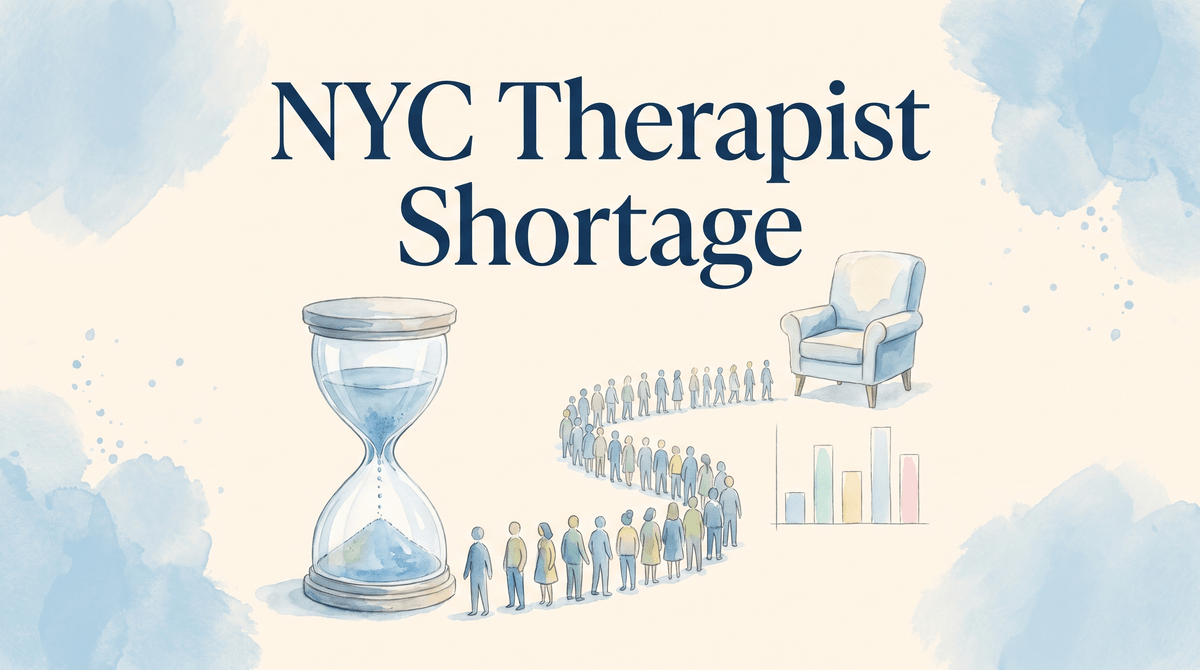
New York City has a mental health access crisis hiding in plain sight. An estimated 945,000 adults in NYC have unmet mental health needs. Major providers have waitlists running into the thousands — The Jewish Board, one of the city's largest nonprofit mental health agencies, has reported a waitlist exceeding 2,000 people and at points stopped adding new names. The problem isn't demand; New Yorkers want care. The problem is supply: there simply aren't enough therapists, the ones who exist are unevenly distributed across boroughs, and the economics of insurance keep many of them out of reach. This is the NYC therapist shortage, by the numbers.
945,000 New Yorkers Who Can't Get Care
The headline figure is staggering on its own: an estimated 945,000 NYC adults have unmet mental health needs — meaning they have a diagnosable condition or significant distress but are not receiving treatment. This represents roughly 1 in 7 adult New Yorkers. The gap is driven by a combination of provider shortage, cost barriers, insurance friction, and stigma. But the supply side is the structural bottleneck: even New Yorkers who are insured, motivated, and actively searching frequently cannot find an available provider within a reasonable timeframe.
"Roughly 1 in 7 adult New Yorkers has an unmet mental health need. This isn't a failure of demand — New Yorkers are actively seeking care. It's a failure of supply, distribution, and economics."
When Providers Stop Taking Names
The clearest symptom of the shortage is the waitlist. When a major nonprofit provider like The Jewish Board accumulates a waitlist exceeding 2,000 people — and reaches a point where it must pause new additions because the backlog is unmanageable — it signals a system operating well beyond capacity. Waitlists of this scale aren't isolated. Community mental health clinics across the city routinely quote new-patient waits of two to four months, and some specialty services (child psychiatry, eating disorder treatment, substance use care) run longer still.
Why Waitlists Have Reached Crisis Levels
The waitlist crisis is the product of several compounding pressures:
- Post-pandemic demand surge — mental health help-seeking rose sharply after COVID-19 and has not returned to pre-pandemic levels, while the provider supply did not grow to match
- Low insurance reimbursement — Medicaid and many commercial plans reimburse therapy at rates that make insurance-based practice financially unsustainable for many clinicians, pushing them to private pay and shrinking the in-network pool
- Clinician burnout and attrition — community mental health clinicians leave the sector at high rates due to caseload, pay, and burnout, creating constant vacancies that lengthen waits for everyone
- Geographic maldistribution — providers concentrate in Manhattan and affluent Brooklyn neighborhoods, leaving the Bronx, southeast Queens, and outer Brooklyn underserved
- Specialty bottlenecks — child and adolescent psychiatrists, in particular, are in critically short supply, so families seeking youth care face some of the longest waits in the system
The Therapist-to-Resident Ratio Is Wildly Unequal
The shortage isn't evenly felt. Manhattan, with its concentration of private-practice therapists, has dramatically more providers per resident than the outer boroughs. The Bronx — the borough with some of the highest rates of mental health need — has the fewest providers relative to its population. This maldistribution means that two New Yorkers with identical insurance and identical conditions can face completely different realities depending on which borough they live in. For residents of underserved areas, the "shortage" is far more acute than the citywide averages suggest.
Mental Health Provider Concentration by Borough
| Borough | Share of Providers | Share of Population | Access Gap |
|---|---|---|---|
| Manhattan | ~60% | ~19% | Heavily oversupplied |
| Brooklyn | ~18% | ~31% | Undersupplied |
| Queens | ~12% | ~27% | Significantly undersupplied |
| Bronx | ~7% | ~17% | Severely undersupplied |
| Staten Island | ~3% | ~6% | Undersupplied |
Source: estimates derived from NYC Health Department provider data and U.S. Census population figures. Provider share is illustrative of the well-documented concentration of mental health professionals in Manhattan and reflects directional reality rather than precise counts. The core finding — that provider distribution does not match where need is greatest — is consistently supported across studies.
Why Having Insurance Doesn't Guarantee Access
One of the cruelest features of the NYC shortage is that insurance coverage doesn't translate to actual access. So-called "ghost networks" — insurance provider directories full of therapists who aren't actually accepting new patients, have moved, or never took that insurance to begin with — are a documented problem in New York. Patients call provider after provider from their insurer's list only to find none are available. The result: people with insurance still end up paying out of pocket, joining months-long waitlists, or simply giving up.
"Roughly 90% of New Yorkers have mental health coverage on paper. But studies have found up to half of in-network directory listings are inaccurate. Coverage and access are not the same thing — and in NYC, the gap between them is where people fall through."
Navigating the Shortage — and Fixing It
The shortage is a systemic problem requiring systemic solutions — higher reimbursement rates, workforce investment, and provider distribution incentives. But individuals navigating it today have practical options that can meaningfully shorten the path to care. Understanding the levers that work — group practices with intake systems, teletherapy that crosses borough lines, and reimbursement-based private pay — can be the difference between waiting four months and starting in two weeks.
Practical Steps If You're Searching Right Now
While the system needs structural reform, these steps can shorten your personal wait:
- Contact group practices directly — practices with several clinicians and an intake coordinator can often match you to an available therapist faster than searching solo providers one by one
- Use teletherapy to bypass geography — a licensed New York State provider can see you by video from anywhere, which sidesteps the Manhattan-concentration problem entirely
- Verify availability before relying on a directory — assume insurer directories are partly inaccurate; call to confirm a provider is actually taking new patients on your plan
- Ask about cancellation lists — even providers with waitlists often have openings from cancellations; explicitly ask to be called for short-notice slots
- Consider out-of-network with reimbursement — if you have PPO benefits, paying privately and submitting for 50–80% reimbursement opens up the much larger pool of out-of-network therapists with shorter waits
What the Numbers Tell Us
The NYC therapist shortage is real, measurable, and getting worse — not because New Yorkers don't want help, but because the system can't supply it where and how it's needed. 945,000 adults with unmet needs, waitlists in the thousands, a provider distribution that ignores where need is greatest, and insurance networks that look adequate on paper but fail in practice. For individuals, the path forward involves understanding the system's quirks well enough to route around them. For the city, it requires the policy will to fix reimbursement rates and rebuild the mental health workforce.
📊 945K Unmet Needs
Roughly 1 in 7 adult New Yorkers has an unmet mental health need. The scale of the gap is the core story.
📋 Waitlists in the Thousands
When a major provider's waitlist tops 2,000 and pauses new names, the system is operating beyond capacity.
🗺️ Geography Is Unequal
Manhattan holds an outsized share of providers while the Bronx and outer boroughs — where need is highest — are starved.
👻 Ghost Networks Are Real
Up to half of insurer directory listings are inaccurate. Having coverage doesn't mean you can actually find care.
💻 Teletherapy Helps
Video therapy with any NY-licensed provider sidesteps the borough maldistribution problem and is often the fastest path in.
🏛️ Reimbursement Is the Fix
The single highest-leverage policy lever is raising insurance reimbursement rates — it directly addresses why providers leave in-network care.